Career planning (MLO 3)
Career planning
– Career progression.
– Profession and salaries.
“Cybersecurity is the practice of protecting systems, networks, and programs from digital attacks.” (Cisco)
• A Specialization in Computer Science
• Conceptual – How to compromise systems
• Hardware – Physical devices and infrastructure
• Software – Operating systems and applications
What you get from higher education:
• Degree (classification, specialization)
• Transferable skills (teamwork, communication, time management, ability to learn)
• Certificates* (CompTIA Security+, GSEC: GIAC Security Essentials Certification)
Career Paths
The main branches for careers with a Computing Science / Cyber Security degree are:
• Academia
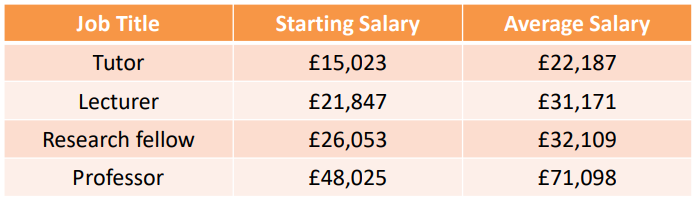
– Research (post-doc, Knowledge Transfer Partnerships)
– Teaching (tutor, lecturer, professor)
• Industry
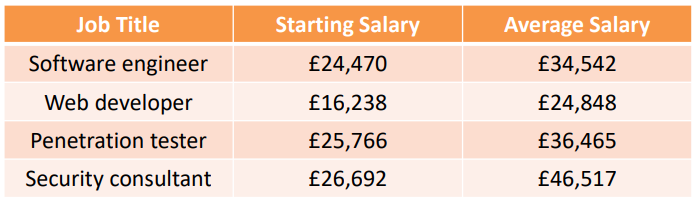
– Computer Software Engineer
– Network Systems & Data Analyst
– Penetration tester
The academic path typically means further study in higher education, where postgraduate qualifications range from a Masters degree to a PhD.
• Masters degree – 1 year
• PhD (Doctor of Philosophy) – 3+ years
Salaries in Academia (UK):
To get into industry, you typically find a job related to your primary goal. For example, an IT job which leads to a computing science/cyber security career:
• Computer Software Engineer
• Network Systems & Data Analyst
• IT Technician
• Web Administrator
Salaries in Academia (UK):
Learning Activity
• Learners to:
– Work individually to identify potential career paths that you have interest in progressing towards (30 minutes).
– Write down in your notes at least two ONE career paths, identifying the progression i.e. job position, salaries, experience and skills required, promotion/advancement possibilities (60 minutes).