What is communication?
Communication is defined as the imparting or exchanging of information by speaking, writing, or using some other medium. All computer systems, single-user or multi-user, interact with the work groups and organizations in which they are used. There is a need to understand normal human-to-human communication.
Face-to-face communication
• Conversation
Text-based communication
• Documentation
• Comments
• Source
– generates data to be transmitted
• Transmitter
– Converts data into transmittable signals
• Transmission System
– Carries data
• Receiver
– Converts received signal into data
• Destination
– Takes incoming data
Simplified Communications Model - Diagram
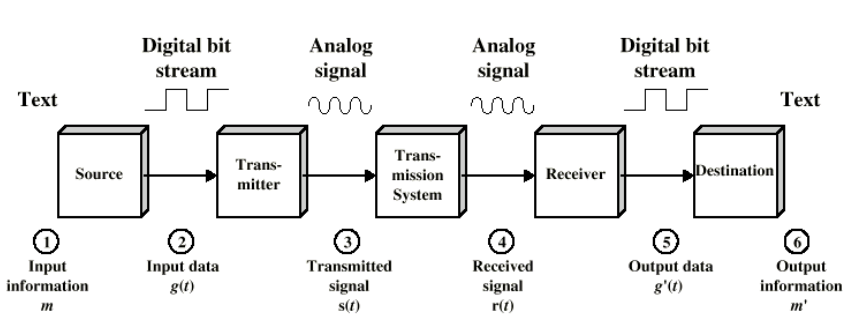
Key Communications Tasks
• Transmission System Utilization
• Interfacing
• Signal Generation
• Synchronization
• Exchange Management
• Error detection and correction
• Addressing and routing
• Recovery
• Message formatting
• Security
• Network Management
Simplified Data Communications Model
Communication in Business
• Communication is any behavior that is perceived by another
– Verbal or Non Verbal
Successful people are proficient in their functional and technical areas.
• They are also communication – oriented
• They are
– Professional
– Empathetic
– Aware
– Concerned for others
Forms of Communication
Communication is an ongoing process
People use symbols to represent their:
– Feelings
– Ideas
– Values
– Perceptions
These symbols are in the form of:
– Verbal communication, either spoken or written
– Non verbal communication
– Graphic communication
Verbal
– Speak clearly
– Choose your words carefully
– Use the appropriate tone
– Consider your audience
– Respond appropriately
Non Verbal
– Eye contact
– Pace of speech
– Facial Expressions
– Posture
– Crossed arms/legs
Graphic
– Visual representation
• Shapes
• Diagrams
• Lines
• Symbols
• images
Listening
– Focus on the person speaking
– Make sure you understand
– Wait for your turn to speak
– Show interest
– Repeat what was said in your own words
Written
–Workplace
– Professional writing
– proper grammar and punctuation
– set of rules
– clear and concise
Emotional Awareness
– Consider other people’s feelings
– Consider your own feelings
– Have empathy
– Operate on trust
– Recognize misunderstandings
Types of Communication
• Four types of communication
Intrapersonal
Interpersonal
Public
Mass
Intrapersonal Communication
• Enable people to communicate with themselves
• This style of communication helps create a person’s self-concept and processes information
• Communication between two people or in small groups
– Ex. Staff instructions, briefing, feedback and customer relations.
• The top 3 competencies for graduates:
–Oral communication
– problem solving
– Self motivation
Public Communication
• Communication between the organization and a number of receivers that originates from one source
– Within the organization (e.g. staff newsletter)
– Outside the organization (e.g. report, stakeholders, shareholders)
• Requires critical thinking and good understanding of the audience
Mass Communication
• Communication with the organizations public
– Public relations
– Annual reports
– Advertising
• Conducted through electronic or print media